Archive | June, 2014

From the ground up

1 Jun

IMG_0305

Michael Studier was in the right place at the right time.

A recent Iowa State graduate, he was applying for a job at a golf course north of Atlanta when he spotted earth-moving equipment nearby. He asked if the course was expanding.

“They said, ‘That’s a new course being built,’” he says.

That course was Capital City Club Crabapple in Woodstock, Ga.

Mike got in on the ground floor of the project, hired as assistant golf course superintendent in 2001. He was promoted to superintendent in 2004.

Crabapple is one of three courses making up the Capital City Club, an exclusive, private club chartered in 1883. The original club is located in downtown Atlanta; the Brookhaven/Country Club is in north Atlanta. At 600 acres, Crabapple is the largest of the three courses; it hosted a PGA event in 2003.

Mike grew up in Dubuque, Iowa, where he worked for the Meadows Golf Club. He attended Iowa State, graduating in 2001 with a bachelor’s degree in horticulture. During his time at Iowa State, Mike interned at the Old Overton Golf Club in Alabama and the Peachtree Golf Club in Atlanta.

“That got me here,” Mike says of his internship in Atlanta. “I wanted to work for the best club possible. There are high expectations here because [members] are paying so much. We have a very high maintenance budget, so there are no excuses.”

Mike hires and supervises a crew of 30 maintenance workers. He oversees the budget, which includes $1 million worth of maintenance equipment. His team is charged with the overall condition of the golf course: all the grasses, plants, trees, and other aspects of the grounds. It’s not an easy job; Mike gets to work at 6 a.m. during the summer – and a leisurely 6:30 a.m. during the off-season. He works long hours, nights, and weekends.

But this is a job he sees himself doing for a long time.

“I love working outside. I’m probably outside 75 percent of the time from April through October.”

Horses, of course

1 Jun

IMG_8301

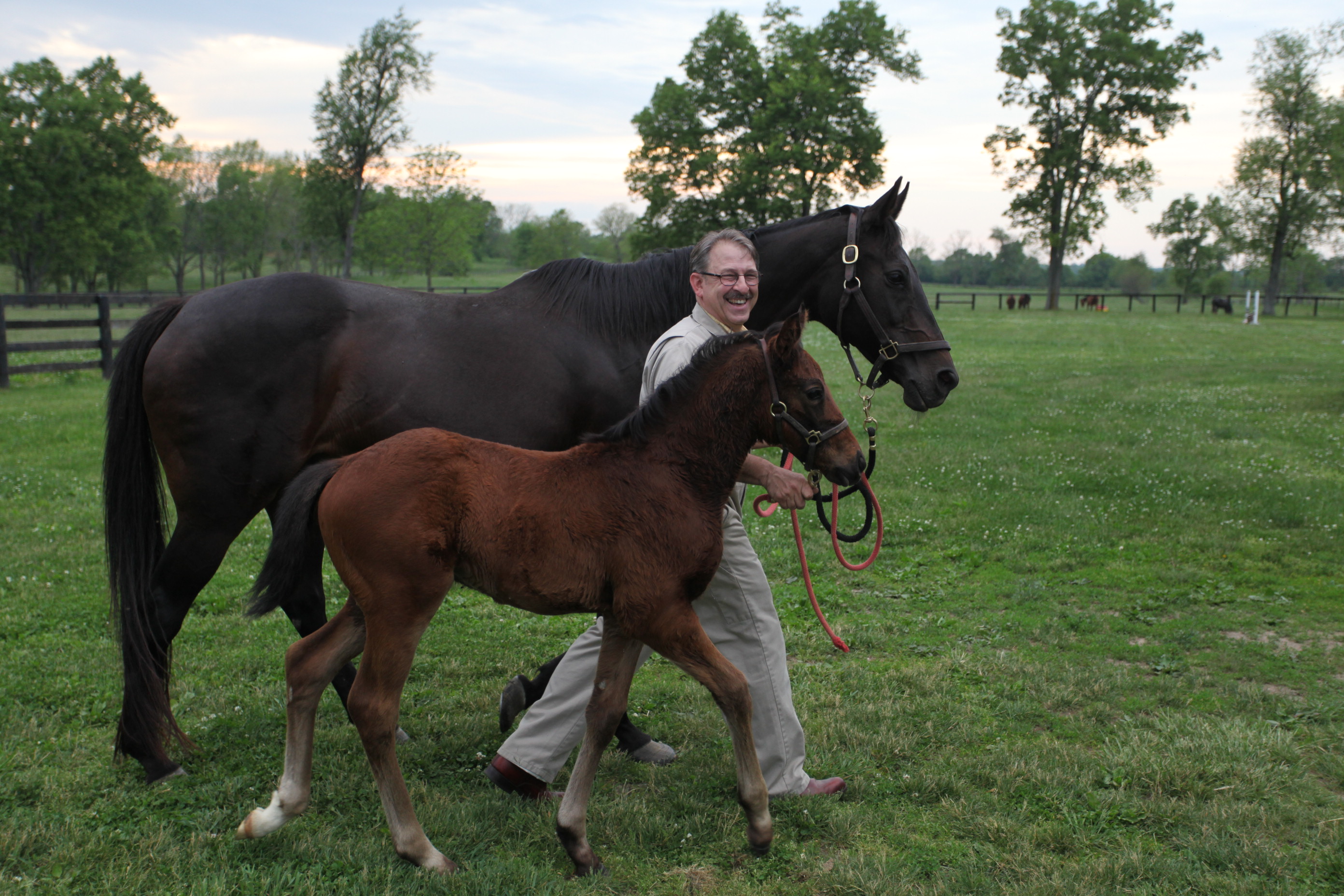
Kentucky is horse country: horses for racing, for showing, for sport, for pleasure. So it’s only natural that Scott Kendall (’84 DVM), an equine veterinarian who hails from Iowa City, Iowa, would choose to settle in the Kentucky Bluegrass Region, often called the horse capital of the world.

Scott is a veterinarian at Woodford Equine Hospital in Versailles, Ky., not far from the city of Lexington. Horse farms abound in the region. Scott describes himself as an “ambulatory” vet, meaning he travels from horse farm to horse farm within a 50-mile radius, aiding in the breeding, foaling, and other health maintenance of thoroughbred horses.

It’s a big job.

“It ends up being more of a lifestyle than a job,” Scott says. “You start early every day. It’s seven days a week…people expect you to be available 24/7.”

And horse breeding is big business: The state of Kentucky produces around 33 percent of all thoroughbred foals born annually in North America. More than 75 percent of Kentucky Derby winners are Kentucky bred, and eight of 11 Triple Crown winners were bred in the state. Top horses have sold for up to $16 million at public auction.

Even when Scott takes off his “doctor” hat, he’s still surrounded by horses. He and his wife, Elise, own a 90-acre horse farm in Paris, Ky., just north of Lexington. They currently have about 20 horses of varying breeds.

And in his spare time?

“I enjoy going to races,” he says. “It’s a big deal in Kentucky.”

Connecting the dots

1 Jun

173F2419

The path that Andrea Vogt-Lytal (’95 journalism) took to become an intelligence analyst for the U.S. Drug Enforcement Agency had about as many twists and turns as the bits of data she regularly analyzes to help identify major drug criminals in Memphis.

Fact No. 1: At Iowa State, Andrea makes a beeline to the study abroad program table at orientation before her freshman year at Iowa State. She chooses to study for a semester in Cuernavaca, Mexico.

Fact No. 2: Although Andrea is a journalism major, she has an epiphany during her Intro to Anthropology class and decides to focus her studies in that area. She conducts research in Mexico.

Fact No. 3: Graduate studies again take Andrea to Mexico. But driving back from her father’s funeral, one day she realizes she isn’t happy doing anthropology.

“I realized I have a little bit more of an activist in me than a theorist, you know?” she said. So she applied for a job at the U.S. Embassy in Mexico City and got a position as an intelligence group assistant for the Drug Enforcement Agency.

“I started in March 2000,” she said. “By July of 2000, I knew what I wanted to be when I grew up. I wanted to be an intelligence analyst.”

Which brings us to Fact No. 4, when suddenly, all the pieces come together. Andrea realized that her journalism background allowed her to excel in writing reports, researching information, and “interviewing bad guys” – all aspects of her new-found career choice. Plus, her extensive experiences in Mexico, Spanish language skills, and understand of the Hispanic culture were a great asset in her new field of work.

“For the first time, it all came together: the journalism; the anthropology; the cultural, historical, geographical knowledge of Mexico; and the Spanish all rolled into one.”

Andrea was hired as an intelligence analyst and spent three years at DEA headquarters in Washington, D.C. In 2005, she moved to Thailand and in 2008 went to work in Memphis at the DEA Memphis Resident Office.

There she spends her days “connecting the dots:” following data leads that the agency hopes will result in the takedown of high-level drug organizations. She follows crumbs of information brought to her by investigators: Maybe a first name or nickname, possibly a physical description or a car license, sometimes a phone number.

“We call these ‘identifiers,’” Andrea explains, “these bits of biographical data. Back in the [DEA] Academy, they said the agents have their gun as their weapon and we have our laptops.”

These cases are not petty misdemeanors. Her office tracks organizations bringing up to 1,000 pounds of marijuana or multiple kilograms of cocaine into the area at a time, netting hundreds of thousands of dollars. Once an investigation ends in an arrest, Andrea assists with search warrants and post-arrest interviews.

“I really like that part,” she says. “But being the tough girl, that is so not me. I’m the one looking at these guys, going, ‘You know, you made so much money you should have just channeled this energy for good, not for evil.’ It just baffles me. It’s not how I was raised, so it’s hard to get inside that world.”

Postscript: In 2014, Andrea will become a DEA intelligence research specialist in Istanbul, Turkey.


Brain man

1 Jun

173F1967

It’s possible that the smartest thing Ken Sufka ever did was crash his eighteen-wheeler on the Pennsylvania Turkpike. Because that action set off a series of serendipitous events that have allowed Ken to live a happy and fulfilling life.

Here’s what happened: Ken was an over-the-road truck driver, happy just to see North America, when that accident persuaded him to quit his job. Left with few alternatives – “I didn’t know what to do, other than I didn’t want to do THAT,” Ken says – he chose to follow in his siblings’ footsteps and enroll at Iowa State University, but he had “no intention of graduating.”

A month into his classwork, he says, he realized that college was not for him and was ready to drop out. Ken called his boss to see if he could get his old job back. His boss said no way. If Ken dropped out of school, he’d never hire him. But if Ken would stay in school, he’d hire him during school breaks, a move that would motivate Ken to stay in school and also help him pay for college.

The next serendipitous event occurred when Ken enrolled in Ron Peters’ Psych 310 Brain and Behavior class at Iowa State. Despite earning a “D” on the first test, Ken was “totally wowed” by the topic and also by Prof. Peters’ teaching mastery. In that class, Ken found his direction. He also found his passion.

“From that moment on, it wasn’t about a bachelor’s degree, not about a master’s degree. It was about becoming a university-level professor,” Ken says.

Ken had a 4.0 every semester after that. He earned his bachelor’s degree in psychology in 1986, followed by a master’s in ’88 and Ph.D. in ’90. He joined the University of Mississippi psychology faculty in 1992, and more than 20 years later he’s loving every minute of it.

“I have a great life because I’m passionate about it,” Ken says. “I love teaching. I love research. I’m happy, and I’m blessed, and I’m the luckiest person around.”

Ken’s passions include a number of diverse research projects – ranging from psychopharmeutical studies on stress, anxiety, and depression to the effects of cancer pain to student learning. (His book, The A Game, was published in 2011.) Ken professes his love for teaching; he routinely teaches introductory psychology to classes that range from 100 to 500 students, and he teaches a “brain class” just like Prof. Peters.

Ken lives on a secluded acreage in Oxford, Miss., where he has built a wood shop, greenhouse, barn, and chicken house in addition to renovating and adding on to his log cabin home. He builds furniture, raises free-range chickens, and rides a Harley-Davidson motorcycle. He recently married a woman, Stevi, with whom he’d been close friends, and the couple has partial custody of her three children.

“Ten years ago I came to terms with what brings me peace and happiness,” he says. “I do things that are soul-nurturing.”

Surviving Katrina

1 Jun

173F2105

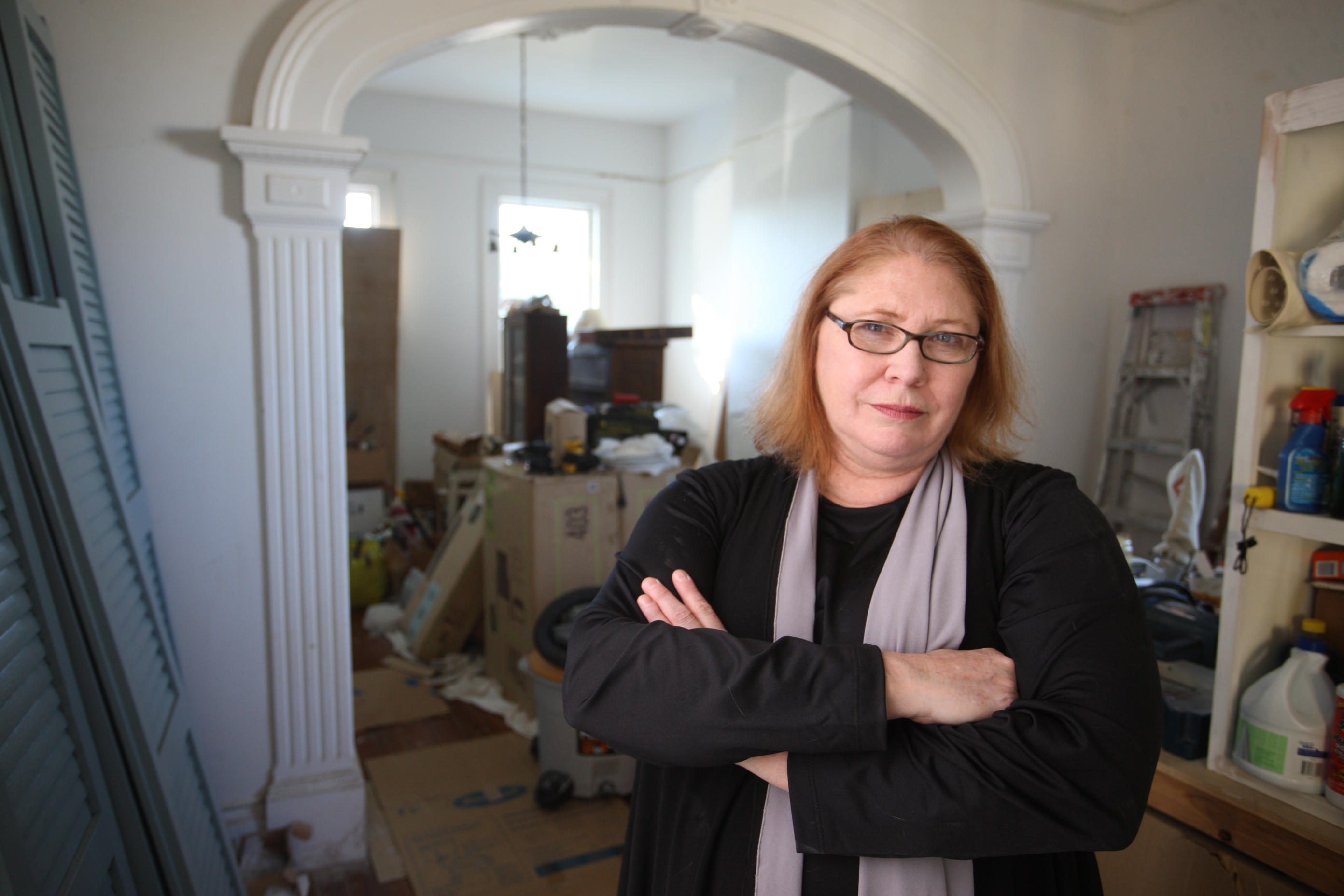
When we met Ann Schexnyder at her pink shotgun house in New Orleans’ Lower 9th Ward in November 2011, it had been six years since Hurricane Katrina.

Yet she was still living without electricity. She was living without a furnace and air conditioning. She still didn’t have hot water.

In fact, she didn’t even have an official occupancy permit to be living in her home, which, following the devastating flood caused by Katrina, had once been filled with three feet of water.

Ann’s story is both unique and similar to every homeowner’s experience in the Lower 9th: The hurricane and flood were just the beginning. The years post-Katrina were the real nightmare.

Ann chose to move to her neighborhood in 2002 for its history and affordability. Her 19-by-100-foot home was built in two stages: one in the 1850s and one in 1910. The back, older half of the house used to be a social club.

That she’s living in her house – after being completely displaced for nine months and living in a FEMA trailer in the backyard for three years – is a testament to Ann’s strength and tenacity.

She had to fight with her insurance company, which for six months insisted she had no homeowners’ insurance. She had to fight with governmental agencies. She got ripped off by unscrupulous contractors.

But she’s rebuilding, little by little. She heads up community meetings. She chases thieves out of her neighborhood.

“Guys would drive by with trailers full of [stolen] doors. I called the cops, but it was like screaming in the dark,” she said of the first two or three years after the flood. “I became [a self-appointed] safety officer. I walked down the streets with a hammer in my hand, [asking these guys], ‘Who are you and what are you doing here?’”

Hurricanes are nothing new to Ann (’85 art & design), who grew up in Louisiana. She also grew up in a house without air conditioning, which helps her deal with her current situation.

“I can tolerate being miserable,” she said. “I’m not bothered by things that bother other people.”

Still, it’s been a battle.

“If it happens again, I’m not doing it,” she told us in November 2011. “It’s not that I couldn’t. I just wouldn’t.”

Postscript: Despite the fact that she still needs to install gutters and finish the floors, Ann now describes her house as “definitely livable.” Some of the work was completed by the crew of “American Horror Story: Coven” after Ann’s home was featured on that television show. “Now that I can see an end to the renovation, I will finally be able to put Katrina behind me,” she says.

In Carver’s footsteps

1 Jun

IMG_2126

Jacquelyn Jackson is a Southern girl at heart. Born and raised in Alabama, she attended Tuskegee University for her bachelor’s and master’s degrees. But then she was lured north by Iowa State University.

“I was on a panel at a plant biotech workshop, and some Iowa State professors were here,” Jackie says. “Afterwards, they came up to me and gave me brochures and information about Iowa State.”

Jackie was still an undergraduate at the time, and she quickly forgot all about the encounter until she completed her master’s degree and began to look for a school to attend for her doctorate.

“When I started thinking about colleges, those Iowa State brochures came back up, and I looked at them. They were so inviting that I thought, you know what? I’m going to try Iowa State.”

Jackie spent six years in Ames working toward her 2008 Ph.D. in plant genetics.

She says that attending the same university as George Washington Carver, who became famous for his scientific research at Tuskegee, was unintentional, though she is well aware that she is following in his footsteps with her focus on genetically engineered sweet potato and peanut plants.

“Carver was a true genius,” she says. “And I can count on my hand how many people I would put in that category.”

Today Jackie is a research assistant professor in the Department of Agricultural and Environmental Sciences at Tuskegee University. Her current project involves cloning disease-resistant sweet potatoes in an effort to boost the root vegetable’s nutritional quality. One of her goals is to increase the amino acids to benefit third-world cultures that don’t have access to animal protein.

“We at Tuskegee still continue Carver’s tradition to work on those two crops – sweet potato and peanut. I guess you could you say Carver has done much of the work for us. If he were here today, it would be amazing what he could have done if he had the technology and the tools that we have. And when you look how complex sweet potato’s genome is, it’s just amazing he did what he did.”

Photo note: Standing in front of the George Washington Carver Museum at Tuskegee University, Jackie holds a sweet potato plant growing in tissue culture, part of a breeding line called W154.

The Sparkle Lady

1 Jun

173F3678

It’s impolite to ask a lady’s age, and Shirley Whipple Koenen isn’t about to tell you hers. But she jokes that you can, more or less, figure it out when she reveals that she and her husband, Leonard, had been married 50 years as of November 2011.

They celebrated the milestone by buying an RV and taking their grown children and their families on a Disney Dream cruise.

“Is that not cool?” she asks, smiling broadly. “I have a lot of people who want me to adopt them.”

Shirley grew up in Hampton, Iowa, where she was the high school homecoming queen. She spent two years in New York after high school – as a “guidette” for NBC Studios and a receptionist for Jack Paar, an early host of The Tonight Show.

“I hate to tell people that, because it dates me,” Shirley laughs.

She returned to the Midwest, married Leonard, her high school sweetheart, and had four daughters.

College came later. Much later. She earned her bachelor’s degree from Wartburg College in Waverly, Iowa, and attended Iowa State for a 1989 master’s in counseling at the same time one of her daughters was enrolled.

As a professional counselor, Shirley adopted the persona of “The Sparkle Lady” – “Feathers and sparkles are my thing,” she says – and her career allowed her to counsel children, teens, couples, and parents for 20 years in California. She also taught summer workshops at Iowa State, training other counselors to use puppets and a sense of humor in their work.

At the peak of her career, she had 150 puppets, all with names and individual personalities. She’s given away most of them over the years, but the few remaining ones travelled with the Koenens when they moved from their home in Bakersfield, Calif., to Bella Vista, Ark., in 2009.

They chose Bella Vista not so much for its seven golf courses as for its cultural attractions and healthy mix of people.

“Don’t put me in a 55-and-older [retirement community],” Shirley says. “I like having children around. My kids say I’ve never grown up.”